Footwear marks and footprints
Footwear marks, bare footprints, trails of footprints, direction of movement, size and sole characteristics.
from RUB 60,000
 trasolog-expert.ruForensic examination of traces
Examination of human and animal traces, marks left by footwear, implements, tools, mechanisms and vehicles, locks, seals, damage to clothing, knots and loops — for courts, investigative authorities, defence lawyers and out-of-court analysis.
Send materialsPhotographs, originals, comparison specimens and documents are considered together. We first determine which questions can be posed on the basis of the available materials.
Choose questions for the expert ↗Forensic trace examination establishes facts from traces and the objects that produce them: the mechanism of trace formation, the direction and method of applying force, the suitability of traces for identification, class membership, contact interaction and the relationship between objects.
Proper documentation of traces, scaled photography, preservation of the object, packaging, comparison specimens and correctly formulated expert questions are important in forensic trace examination.
Footwear marks, bare footprints, trails of footprints, direction of movement, size and sole characteristics.
Drilling, cutting, prying, forced entry, chopping, breaking, scratches, dents and damage.
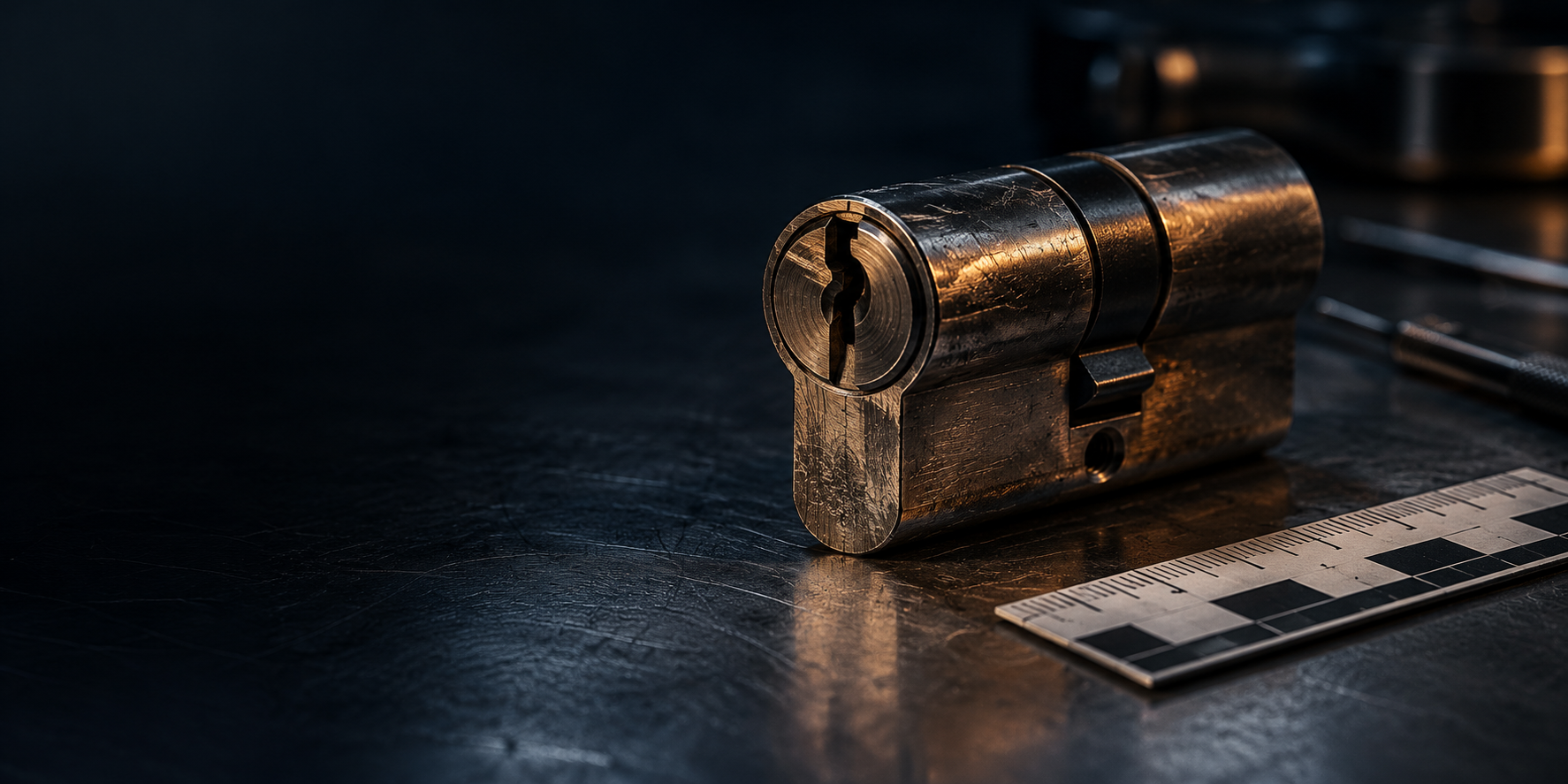
Examination of locks, keys, seals and signs of forced opening, damage or reuse.
Vehicle traces, tyres, components, damage and the contact mechanism in a road traffic accident.
Tears, cuts, punctures, marks left by objects and the mechanism of damage formation.
Checking a report: trace documentation, methodology, specimens, conclusions, competence and errors.
Expert assistance with forensic trace examination, preparation of questions and report reviews.
Advanced training in forensic trace and impression examination.
Expert practice since 2020.
Andrei Viktorovich is a member of SUDEX.
His professional liability as a forensic expert is insured with Absolut Strakhovanie LLC for RUB 5,000,000.
Work is performed within the questions posed, the type of objects, the preservation of traces and the sufficiency of comparison specimens. Where a multidisciplinary examination involving automotive engineering, commodity examination, materials science or other tasks is required, specialists in the relevant fields are involved.
An expert examination does not replace legal assessment or conclusions on guilt, the admissibility of evidence or the legal classification of conduct. Such questions are resolved by the court, investigative authorities, inquiry authorities or a lawyer.
For a preliminary discussion, it is important to distinguish the item bearing the trace from the object proposed for comparison. A photograph of damage to a door and a photograph of a tool serve different purposes. The description should state where each item is located, what condition has been preserved and which questions need to be answered.
If several traces are submitted, give them clear identifiers and link them to the overall view of the object. A close-up is useful for details, while the overall view shows location and relative orientation. Without this link, similar images may mistakenly be assigned to different areas or combined as a single trace.
If only photographs have survived, state whether the source files and the object itself are available. A screenshot, a forwarded reduced-size copy and a source photograph may contain different amounts of visual information. The possibility of examining an image preliminarily does not mean that it already permits an identification conclusion.
A useful initial question may concern the damage mechanism, trace suitability or comparison with a particular item. These tasks differ. Determining the general type of action and establishing a single source of the trace require different levels of sufficient features, so the expected answer is discussed in relation to the surviving material.
| Footwear marks and footprints | from RUB 60,000 |
| Implement and tool marks | from RUB 70 000 |
| Locks, seals and locking and sealing devices (ЗПУ) | from RUB 70 000 |
| Forensic vehicle trace examination | from RUB 80,000 |
| Damage to clothing | from RUB 70 000 |
| Review of an expert report | from RUB 60,000 |
The exact cost depends on the number of objects, complexity of traces, need for comparative examinations or a site visit, urgency and the scope of the report.
These timeframes apply to standard assignments and begin after the order has been agreed, the complete set of materials has been received and the agreed payment conditions have been met.
The complexity of the assignment, the volume of materials and the involvement of other specialists may extend the timeframe. The exact timeframe and scope of work are recorded in the order before work begins.
Preliminarily, yes, but an expert conclusion depends on quality, scale, viewing angle, preservation of the trace and availability of comparison materials.
In some cases this is possible if the mark is suitable for identification and the tool itself or comparison specimens of its marks are available.
It must not be washed, cleaned, dismantled, rubbed, repackaged unnecessarily or mixed with other objects.
Yes, a review can be prepared analysing trace documentation, methodology, comparison specimens and the substantiation of conclusions.
Typical scenario
Suppose a dent in a container and a mark on its latch are noticed after transport. One party attributes both to an impact, while another suggests a separate action during opening.
Typical scenario
If a small impression fragment is found on packaging or another surface and footwear is submitted for comparison, a similar tread pattern does not yet identify a particular pair. The first questions concern which areas are actually recorded and whether the impression itself remains available. A photograph without a known scale may show the general tread design while limiting dimensional comparison.
You may send photographs of traces, damage, locks, seals, footwear, tools or vehicles, a court ruling, an investigative order, draft questions or a report for review.